
About the Project
SOMPATY was an international research collaboration bringing together universities and research institutions from Azerbaijan, the Czech Republic, Germany, Kazakhstan, Ukraine and Uzbekistan.
Coordinator: The tasks of the Coordinator include: monitoring the project, acting as the official, contact with the European Commission, chairing the Supervisory Board.
Supervisory Board: The Supervisory Board is composed of leading staff representatives from all eight institutions. The Board is responsible for the coordination of the deliverables. This includes assessment of progress reports, maintenance of work plans, and conflict resolution.
Organization structure

Partners, WP, and Topics

SOMPATY was an international research collaboration bringing together universities and research institutions from Azerbaijan, the Czech Republic, Germany, Kazakhstan, Ukraine and Uzbekistan.
The aim of the SOMPATY project is to strengthen research ties between Europe and the Commonwealth of Independent States (CIS), particularly the CIS countries in Asia Minor and Central Asia.
The project focuses on an intensive staff exchange, which will lead to collaborative research and training between universities and research organizations from Azerbaijan, the Czech Republic, Germany, Kazakhstan, Ukraine, and Uzbekistan.
- The task is organized into four Work Packages with 154 person months.
- Several important project events are scheduled:
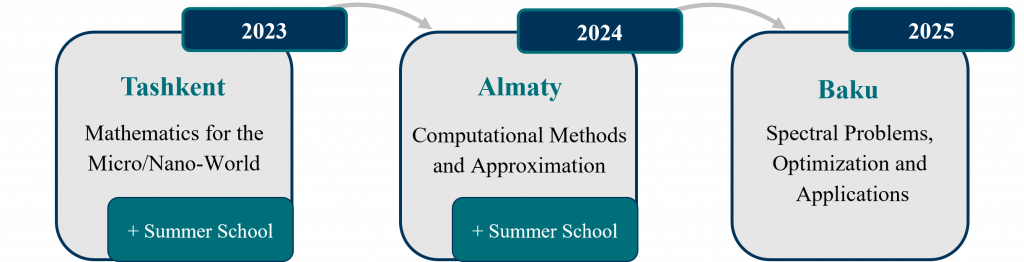
- 4 scientific workshops (Tashkent’23, Almaty’24, and Kyiv’25)
- 2 summer schools
- public outreach activities
Specific objectives and the relevance of the research & innovation action
Key research questions include
WP 1: Numerical schemes for indefinite Sturm-Liouville problems & spectral analysis of signals
WP 2: Linear & nonlinear models of branched structures
WP 3: Spectral theory of singular perturbations and inverse problems
WP 4: Approximation theory & theory of function spaces
Research and innovation objectives
- To model optical fibre networks, nanoscale waveguides and branched structures, nanomaterials and metamaterials including dissipative materials.
- To contribute to the understanding of novel types of metamaterial structures.
- To deepen spectral optimization methods in inverse problems for integrated circuits.
Objectives
The collaborative research is organized within the Work Packages (WPs).
WP 1 Numerical schemes for indefinite Sturm-Liouville problems & spectral analysis of signals
- Numerical schemes for the non-real spectrum of indefinite Sturm–Liouville operators
- PT-symmetric operators on complex contours
- Perturbation theory for differential algebraic equations
- Re-design of integrated circuits
WP 2 Linear & nonlinear models of branched structures
- Spectral properties of networks, in both classical and leaky models; analysis and control
- Beyond self-adjoint dynamics: dissipative and nonlinear networks
WP 3 Spectral theory of singular perturbations and inverse problems
- Spectral analysis of differential operators with distribution coefficients.
- Solvability of ill-posed problems of normal and generalized normal type for non-local boundary value problems
- Spectrum of elliptic differential operators with nonlocal and non-coercive boundary conditions.
- Spectral theory of quantum-mechanical operators with nonlocal potentials.
- Direct and inverse spectral problems for quantum graphs with nonlocal potentials.
- Optimization of spectral data in inverse spectral problems for special matrices.
- Direct and inverse scattering problems for hyperbolic equations, application to the theory of solitons.
WP 4 Approximation theory & theory of function spaces
- Localization properties of bases and frames on the multivariate torus
- Construction of bases and frames on more general manifolds
- Algorithms and their approximation order for non-linear and adaptive processes based on general sampling strategies
- Investigation of error and stability estimates for the different function spaces involved.
WP 5 Dissemination, exploitation and outreach
Dissemination activities (months 21-66): Preparation of the four workshops and two summer schools in the years 2020-2023 with all partner teams attending:
- Exploitation activities (months 21-66): Presentation of SOMPATY outcomes in relevant professional international conferences. Exploitation plan will be updated on an annual basis, taking into account relevant project deliverables and the marketing policies of the participants.
- Communication activities (months 21-66): Organization of public presentations, which will be properly advertised to generate the necessary audience interest; outreach activities; organization of project events with media participation; global access and dissemination of information about the project through the internet and the creation of the project website; videos.
WP 6 Ilmenau: Project management
- Project Coordination (months 21-66): Permanent management of the project actions: circulation of information between the partners; organization of Supervisory Board meetings; coorganization of workshops and other communication events; development of strategic plans and tactical schemes for effective project performance; supervision of the progress of the project; overall legal, contractual, ethical, financial and administrative management of the consortium; preparation, updating and management of the Consortium Agreement between the participants.
- Monitoring (months 21-66): Monitoring the research activities and the corresponding staff secondments of the project; monitoring the risk factors, e.g. delay, underperformance etc.
- Quality management and administrative matters (months 21-66): Internal audit of the project activities, paying special attention to measurements that can guarantee the conformity of the project to the requirements of the European Charter for Researchers, the Code of Conduct for the Recruitment of Researchers, and Rules of Good Scientific Practice.
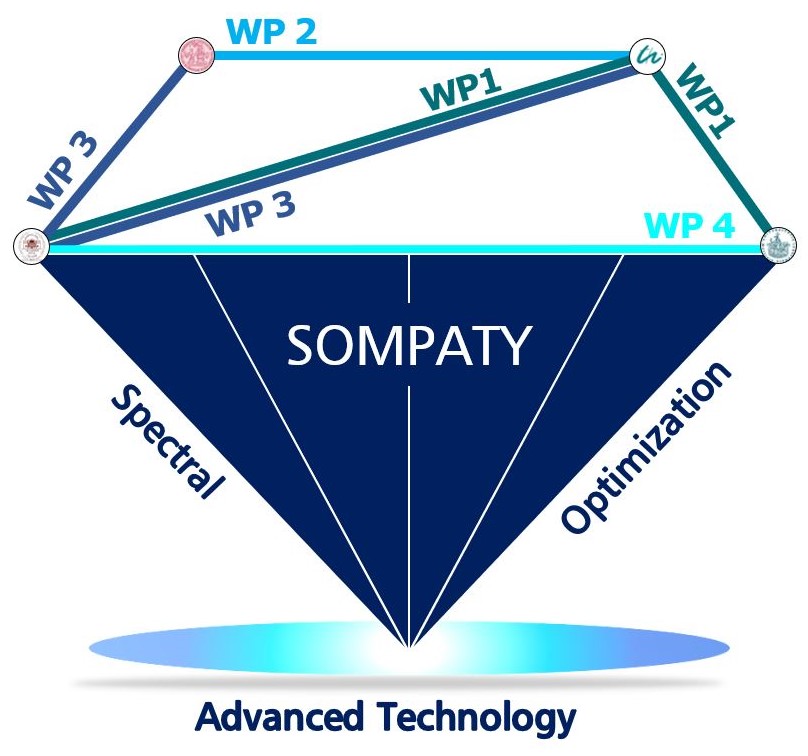
The task is organized into four Work Packages (WP) with 154 person months.
WP 1 Ilmenau: #Alm#Baku
(person months: 47; Ilmenau)
WP 2 Prague: #Alm#Tash
(person months: 48; Prague)
WP 3 Kyiv: #Baku#Tash
(person months: 48; Kyiv)
WP 4 Lübeck: #Alm#Baku
(person months: 49; Lübeck)
WP 5 Kyiv: Dissemination,
exploitation and outreach
WP 6 Ilmenau:
Project management
Project Consortium



Beneficiaries
Technische Universität Ilmenau, Ilmenau, Germany
- will PT symmetry and applications to metamaterials,
- quantum graphs in terms of extension theory,
- perturbation and spectral theory
- perturbation theory for DAEs and applications to the optimization of integrated circuits
Nuclear Physics Institute of the Czech Academy of Sciences Prague, Czech Republic
- will quantum graph models and PT symmetric operators in combination with metamaterials,
- singular Schrödinger and Dirac operators,
- leaky quantum structures
- dissipative and/or many-body effects in graphs and optical fibres.
Institute for Mathematics, National Academy of Sciences of Ukraine, Ukraine, Kyiv
- spectral theory
- inverse problems and
- differential equations.
Universität zu Lübeck, Lübeck, Germany
- will all data-driven approaches for the numerical solution of the operator equations,
- fast algorithms for different approximation methods and stability,
- convergence and localization results,
- non-linear and adaptive variants for all approximation theoretical results.
Institute of Mathematics of the University of Georgia (IMUG), Tbilisi, Georgia
Partners
Institute of Mathematics and Mathematical Modelling, Almaty, Kazakhstan
- non-local boundary value problems for hyperbolic integro-differential equations
- nonlocal boundary value problems.
- Qualitative properties of boundary value problems for parabolic integro-differential equations
Turin Polytechnic University Tashkent, Tashkent, Uzbekistan
- Linear and nonlinear PDEs on metric graphs
- PT-symmetry and soliton solutions
- Numerical solutions of PDEs on branched domains
Activities & Highlights
Thematic Workshops and Summer Schools
Kyiv, Ukraine
May 12-16,2025
International Workshop within the framework of the HORIZON-2020 project SOMPATY
Institute of Mathematics of the National Academy of Ukraine organises one-week workshop within the framework of the EU Project SOMPATY "Spectral Optimisation: From Mathematics to Physics and Advance Technology" whose aim consists of disseminating the ideas/results between Ukrainian and foreign project teams who suffer a lack of direct `offline' communications due to military aggression of the russian federation, as well as involving new scientific partners/teams. An important goal should be providing an opportunity to young scientists from Ukraine to report their results at a high international level with a forthcoming perspective of establishing collaborative contacts. The Workshop intends to held in a hybrid form with NO registration fee for Ukrainian speakers even though they do not belong to Ukrainian team of SOMPATY. Plenary (invited) speakers would deliver 30-60min lectures but other participants are offered to deliver 15-20min talks. No special sections are scheduled. All should hear all.
→ Plenary lectures & Talks
→ Work Program
Almaty, Kazakhstan
September 11-18, 2024
International Summer School (Sept 11-14) and Conference (Sept 16-18)
on
→ Evolution Equations, Approximation and Spectral Optimization
There are some photos from the SOMPATY summer school and conference in Almaty available on the website: https://sites.google.com/view/eeaso-2024/photo-gallery?authuser=0
Samarkand, Uzbekistan
September 11-20, 2023
International Summer School and Conference
Thematic Seminars
13th Sompaty seminar
Thursday, February 17 at 9 am
Illia Karabash
TU Dortmund and IAMM of NAS of Ukraine
Title of the talk:
A description of m-dissipative boundary conditions for Maxwell operators and its electrodynamics applications
Motivated by modeling of leaky optical cavities, we give a description of
all m-dissipative boundary conditions for Maxwell operators in Lipschitz domains.
If time allow us, it is planned to show applications of this description to Leontovich boundary conditions
and to the cases of degenerate and random impedance coefficients.
The talk is based on a joint research with Matthias Eller.
12th Sompaty seminar
Monday, January 24 at 11:30 am
Martina Hentschel
Institute for Physics, TU Chemnitz, Germany
Title of the talk:
PT symmetry in mesoscopic systems
Short discussion
Monday, January 10 at 11:30 am
Short meeting
in order to coordinate our activities.
11th Sompaty seminar
Thursday, November 25 at 9am
Alexandra Antoniuk
Institute of Mathematics of the National Academy of Sciences of Ukraine
Title of the talk:
🗎 Pseudo-differential equation with spatial p-adic variables and some of their applications
10th Sompaty seminar
Thursday, November 11 at 9am
Elvin I. Azizbayov
The Academy of Public Administration under the President of the Republic of Azerbaijan, Baku
Title of the talk:
🗎 Nonlinear Inverse Problem for the Equation of Propagation of Longitudinal Waves with non-self-adjoint Boundary Conditions
9th Sompaty seminar
Thursday, October 21 at 9am
Carsten Trunk
Institut für Mathematik, Technische Universität Ilmenau
Title of the talk:
🗎 Sturm-Liouville, PT-symmetric operators and differential algebraic
8th Sompaty seminar
Thursday, September 30 at 9am
Jambul Yusupov
Laboratory for Advanced Studies, Turin Polytechnic University in Tashkent
Title of the talk:
Modeling and design of PT-symmetric networks: Quantum transport, soliton dynamics and dissipation effects
We discuss extension of PT-symmetric quantum physics and soliton theory to the case of networks. In particular, we provide an approach for designing
PT-symmetric quantum graphs. Also, we discuss the problem of sliton
dynamics in networks. Relation of the both problems to the issue of
dissipative networks will be also discussed.
7th Sompaty seminar
Thursday, September 9 at 9 am
Kateryna Pozharska
Institute of Mathematics of NAS of Ukraine, Kyiv, Ukraine
We will discuss the recovery of multivariate functions from reproducing kernel Hilbert spaces in the uniform norm. We study a certain weighted least squares algorithm that uses the so-called ”standard information”, i.e., finite number of function values at some points. The main advantage of our approach is that the nodes are taken at random w.r.t. a tailored distribution and simultaneously for the whole class of functions. We show that the considered deterministic algorithm leads to near optimal results in several relevant situations. We additionally apply a recently introduced sub-sampling technique to further reduce the sampling budget.
6th Sompaty seminar
Thursday, August 19 at 9am German time
Anar T. Assanova
Institute of Mathematics and Mathematical Modeling, Almaty, Kazakhstan
Title of the talk:
Constructive methods for solving nonlocal boundary value problems for integro-differential equations PT-symmetry
This talk is devoted to boundary value problems for Fredholm integro-differential equations and constructive methods for solving them. We will discuss the effectiveness of the Dzhumabaev parametrization method for solving nonlocal boundary value problems. We consider the questions on existence and uniqueness of solutions to boundary value problems for hyperbolic Fredholm integro-differential equations. We also present our recent research results on boundary value problems for Fredholm integro-differential equations and numerical and approximate methods for solving boundary value problems with parameter. We report about some results of boundary value problems for parabolic Fredholm integro-differential equations.
5th Sompaty seminar
Thursday, August 5 at 9am German time
Jürgen Prestin
Universität Lübeck
Title of the talk:
Multivariate Trigonometric Wavelets and Shearlets
4th Sompaty seminar
Thursday, July 22 at 9am German time
Fikret Aliev
Institute of Applied Mathematics, Baku State University, Baku, Azerbaijan
Title of the talk:
🗎 Some mathematical problems and their solution for problem of oscillatory systems with liquid dampers
3rd Sompaty seminar
Thursday, July 1 at 9 am
Pavel Exner
Doppler Institute for Mathematical Physicsand Applied Mathematics, Prague
Title of the talk:
Quantum graphs: time-reversal non-invarianceand PT-symmetry
The talk concerns effects coming from a violation of time-reversal symmetryin the vertex coupling of quantum graphs, focusing on the situation when theasymmetry is maximal at a fixed energy. It is shown that such a coupling hasa topological property: scattering at the vertex in the high-energy regimedepends substantially on the vertex parity. We explore implications of thisfact for spectral and transport properties in several classes of graphs, bothfinite and infinite periodic ones. We also identify a class of vertex couplingexhibiting a nontrivialPT-symmetry despite being self-adjoint. The resultscome from a common work with Marzieh Baradaran, Jiří Lipovský, andMiloš Tater.
2nd Sompaty seminar
Thursday, June 10 at 9am German time
Oleksandr Burylko
Leading researcher, Dep. of Differential equations and oscillation theory of the Institute of Mathematics NAS of Ukraine
Title of the talk:
🗎 Collective dynamics in networks of phase oscillators
The talk is dedicated to the description of collective dynamics in the networks of phase oscillators of the Kuramoto type. I plan to show how the architecture and symmetry of the network, individual dynamics, and the interaction functions affect the emergence, structure, stability, and bifurcations of different collective regimes (synchronization, clustering, splay states, antiphase regimes, slow switching, chimera state, etc.).
1st Sompaty seminar
Thursday, May 20 at 9am German time
Davron Matrusulov
Laboratory for Advanced Studies, Turin Polytechnic University in Tashkent
Title of the talk:
🗎 Tunable quantum networks: Modeling and design transparent and PT-symmetric quantum graphs
In this talk I will briefly introduce the concept of quantum graph as model of branched quantum structures and discuss how to make their branching points (vertices) transparent, i.e. providing reflectionless transmission of waves/particles through these points. Also, I willl introduce concept of PT-symmetric (non-Hermitian) quantum graphs and provide sketch for their experiemntal realization.
Results & Publications
Journal Articles
Conference Papers / Proceedings
Preprints / Other
Open Access EU
Journal Articles
- Jürgen Prestin, Viktor Savchuk, Andrii Shidlich.Approximation on hexagonal domains by Taylor-Abel-Poisson means.Journal of Mathematical Analysis and Applications 528(2), 2023.
- A. T. Assanova, E. A. Bakirova, R. E. Uteshova.Novel approach for solving multipoint boundary value problem for integro-differential equation.Kazakh Mathematical Journal 20(1), 2020, pp. 103–124.
- A. Abildayeva, A. Assanova, A. Imanchiyev.A Multi-Point Problem for a system of Differential Equations with Piecewise-Constant a Argument of generalized Type as a Neural Network Model.Eurasian Mathematical Journal 13(2), 2022, pp. 8–17.
- Valerii Los, Vladimir Mikhailets, Aleksandr Murach.Parabolic problems in generalized Sobolev spaces.Communications on Pure and Applied Analysis 20(10), 2021, pp. 3589–3620.
- Anna Anop, Robert Denk, Aleksandr Murach.Elliptic problems with rough boundary data in generalized Sobolev spaces.Communications on Pure and Applied Analysis 20(2), 2021, pp. 697–735.
- Andrii Goriunov.Multi-interval Sturm-Liouville problems with distributional coefficients.Methods of Functional Analysis and Topology 26(2), 2020, pp. 103–110.
- Iryna Chepurukhina, Aleksandr Murach.Elliptic problems with unknowns on the boundary and irregular boundary data.Methods of Functional Analysis and Topology 26(2), 2020, pp. 91–102.
- A. A. Boichuk, S. M. Chuiko.On the approximate solution of weakly nonlinear boundary-value problems by the Newton–Kantorovich method.Journal of Mathematical Sciences 261(2), 2022, pp. 228–240.
- Oleksandr Boichuk, Victor Feruk.Boundary-value problems for weakly singular integral equations.Discrete and Continuous Dynamical Systems – Series B 27(3), 2022, pp. 1379–1395.
- A. Anop, I. Chepurukhina, A. Murach.Elliptic problems with additional unknowns in boundary conditions and generalized Sobolev spaces.Axioms 10(4), 2021, Article 292.
- D. S. Bihun, O. O. Pokutnyi, E. V. Panasenko.Autonomous nonlinear boundary-value problems for the Lyapunov equation in the Hilbert space.Ukrainian Mathematical Journal 73(7), 2021, pp. 1009–1022.
- Fahreddin Abdullayev, Stanislav Chaichenko, Andrii Shidlich.Direct and inverse approximation theorems of functions in the Musielak-Orlicz type spaces.Mathematical Inequalities & Applications 24(2), 2021, pp. 323–336.
- A. S. Serdyuk, T. A. Stepanyuk.Asymptotically best possible Lebesgue-type inequalities for the Fourier sums on sets of generalized Poisson integrals.FILOMAT 34(14), 2020, pp. 4697–4707.
- Anatolii S. Serdyuk, Igor V. Sokolenko.Asymptotic Estimates for the Best Uniform Approximations of Classes of Convolution of Periodic Functions of High Smoothness.Journal of Mathematical Sciences 252(4), 2021, pp. 526–540.
- A. S. Serdyuk, I. V. Sokolenko.Asymptotic estimates for the widths of classes of functions of high smoothness.Carpathian Mathematical Publications 15(1), 2023, pp. 246–259.
- A. Serdyuk, T. Stepaniuk.Approximation of generalized Poisson integrals by interpolating trigonometric polynomials.Ukrains’kyi Matematychnyi Zhurnal 75(7), 2023.
- Nazarbay Bliev, Nurlan Yerkinbayev.Riemann problem for multiply connected domain in Besov spaces.Boundary Value Problems, Article 70, 2024.
- J. Dittrich, S. Rakhmanov, D. Matrasulov.Dirac particle under dynamical confinement: Fermi acceleration, trembling motion and quantum force.Physics Letters A 503, 2024.
- Pavel Exner, Jan Pekař.Vertex coupling interpolation in quantum chain graphs.Journal of Mathematical Physics 65, 2024.
- S. Rakhmanov, C. Trunk, M. Znojil, D. Matrasulov.PT-symmetric dynamical confinement: Fermi acceleration, quantum force, and Berry phase.Physical Review A 109, 2024.
- Marzieh Baradaran, Pavel Exner, Andrii Khrabustovskyi.Quantum lattice transport along an infinitely extended perturbation.Journal of Physics A: Mathematical and Theoretical 58, 2025.
- Pavel Exner.Quantum graphs featuring unusual self-adjoint extensions.Acta Polytechnica 65, 2025.
- Riccardo Adami, Ivan Gallo, David Spitzkopf.Ground states for the NLS on non-compact graphs with an attractive potential.Networks and Heterogeneous Media 20, 2025.
- Kuvonchbek Matchonov, Davron Matrasulov, Jaroslav Dittrich.Dirac fermion in a time-dependent spherical box.Acta Polytechnica 65, 2025.
- Ram Band, Pavel Exner, Divya Goel, Aviya Strauss.Spectral statistics of preferred orientation quantum graphs.Journal of Mathematical Physics 67.Publisher: https://pubs.aip.org/
- Pavel Exner, Olaf Post.First order operators on shrinking graph-like spaces.Journal of Physics A: Mathematical and Theoretical 58, 2025.
- Pavel Exner, Léo Morin.The flea on the Magnetic Elephant.Letters in Mathematical Physics 116.
- Pavel Exner, David Spitzkopf.Tunneling in soft waveguides: closing a book.Journal of Physics A: Mathematical and Theoretical 57.
- Pavel Exner, Jonathan Rohleder.Optimization of Quantum Graph Eigenvalues with Preferred Orientation Vertex Conditions.Annales Henri Poincaré.
- Pavel Exner, David Spitzkopf.Magnetic transport due to a translationally invariant potential obstacle.Journal of Mathematical Physics 66.
- V. A. Derkach, C. Trunk, J. R. Yusupov, D. U. Matrasulov.Transparent boundary conditions for the stationary Schrödinger equation via Weyl–Titchmarsh theory.Journal of Physics A: Mathematical and Theoretical 58.
- Anar T. Assanova, Elmira A. Bakirova, Zhazira M. Kadirbayeva, Roza E. Uteshova.A computational method for solving a problem with parameter for linear systems of integro-differential equations.Computational and Applied Mathematics 39, 2020.
- Fikret A. Aliev, N. A. Aliev, N. I. Velieva, N. A. Safarova.Larin Parameterization to Solve the Problem of Analytical Construction of the Optimal Regulator of Oscillatory Systems with Liquid Dampers.Journal of Applied and Computational Mechanics 6(SI), 2020, pp. 1426–1430.
- F. A. Aliev, V. B. Larin, G. H. Mammadova.Comments on “On a transformation of the *-congruence Sylvester equation for the least squares optimization”.TWMS Journal of Pure and Applied Mathematics 12(2), 2021, pp. 289–290.
- Fikret Aliev, N. A. Aliyev, N. S. Hajiyeva, N. I. Mahmudov.Some Mathematical Problems and their Solutions for the Oscillating Systems with Liquid Dampers: A Review.Applied and Computational Mathematics 20(3), 2021, pp. 339–365.
- Anar T. Assanova, Roza E. Uteshova.A singular boundary value problem for evolution equations of hyperbolic type.Chaos, Solitons and Fractals, 2021.
- P. A. Cojuhari, L. P. Nizhnik.Scattering problem for Dirac system with nonlocal potentials.Methods of Functional Analysis and Topology 25(3), 2019, pp. 211–218.
Conference Papers / Proceedings
- L. Nizhnik.Self-adjoint operators with nonlocal potential.In: Proceedings of the 7th International Conference on Control and Optimization with Industrial Applications (COIA 2020), Vol. 1, Baku, 26.–28. August 2020, pp. 20–22.
- F. A. Aliev, N. A. Aliev, N. A. Safarova.New representation of the Mittag-Leffler function through the exponential functions with rational derivatives.In: Proceedings of the 7th International Conference on Control and Optimization with Industrial Applications, Vol. 1, 2020, pp. 80–82.
- F. A. Aliev, N. S. Hajiyeva, A. A. Namazov, N. A. Safarova.Asymptotical method to solution the identification problem for determining the parameters of discrete dynamical systems.In: Proceedings of the 7th International Conference on Control and Optimization with Industrial Applications, Vol. 1, 2020, pp. 92–94.
- N. A. Aliev, N. A. Safarova, F. A. Aliev, N. I. Velieva.Cauchy problem of the fractional order linear ordinary differential equations.In: Proceedings of the 7th International Conference on Control and Optimization with Industrial Applications, Vol. 1, 2020, pp. 101–103.
- A. S. Serdyuk, I. V. Sokolenko.Asymptotic estimates for the best uniform approximations of classes of convolution of periodic functions of high smoothness.In: The international scientific conference “Theory of approximations and its application” dedicated to the 100th anniversary of the birth of Mykola Pavlovich Korneychuk, Dnipro, 16.–19. September 2020, Book of Abstracts, p. 25.
- A. S. Serdyuk, I. V. Sokolenko.Estimates for best uniform approximations of classes of convolutions of periodic functions of high smoothness.In: 11th International Skorobohatko Mathematical Conference, Lviv, 26.–30. October 2020, Abstracts, p. 103.
- A. S. Serdyuk, I. V. Sokolenko.On asymptotic estimates for the widths of classes of functions of high smoothness.In: International Online Workshop on Approximation Theory (IOWAT-2021), Ivano-Frankivsk, 19.–21. March 2021, Book of Abstracts, p. 34.
- A. S. Serdyuk, I. V. Sokolenko.On asymptotic equations for the widths of classes of the generalized Poisson integrals.In: Mathematical Analysis, Differential Equations & Applications (MADEA-9), Bishkek, 21.–25. June 2021, Conference Abstracts, p. 73.
- A. S. Serdyuk, I. V. Sokolenko.Asymptotic behavior of the widths of classes of the generalized Poisson integrals.In: International scientific online conference “Algebraic and geometric methods of analysis”, 29. May – 1. June 2023, Book of Abstracts, pp. 109–111.
- A. S. Serdyuk, I. V. Sokolenko.Approximation by interpolation trigonometric polynomials in the classes of Weyl-Nagy differentiable functions with high exponent of smoothness.In: International scientific conference “MATHEMATICS AND INFORMATION TECHNOLOGIES”, dedicated to the 55th anniversary of the Faculty of Mathematics and Informatics of Yuri Fedkovich Chernivtsi National University, Chernivtsi, 28.–30. September 2023, Book of Abstracts.
- Anar T. Assanova, Askarbek E. Imanchiyev.A nonlocal problem for hyperbolic equations with impulse discrete memory.In: International scientific conference “MATHEMATICS AND INFORMATION TECHNOLOGIES”, dedicated to the 55th anniversary of the Faculty of Mathematics and Informatics of Yuri Fedkovich Chernivtsi National University, Chernivtsi, 28.–30. September 2023, Book of Abstracts.
- A. Boichuk, V. Feruk.A weakly perturbed linear boundary value problem for a system of differential equations of fractional order.In: International scientific conference “MATHEMATICS AND INFORMATION TECHNOLOGIES”, dedicated to the 55th anniversary of the Faculty of Mathematics and Informatics of Yuri Fedkovich Chernivtsi National University, Chernivtsi, 28.–30. September 2023, Book of Abstracts.
- A. S. Serdyuk, I. V. Sokolenko.Estimations of the widths of classes of the generalized Poisson integrals of periodic functions.In: Current Problems of Mechanics and Mathematics – 2023: Collection of Scientific Papers, 2023, pp. 307–308.
Preprints / Other
- S. Rakhmanov, C. Trunk, D. Matrasulov.Quantum particle under dynamical confinement: From quantum Fermi acceleration to high harmonic generation.arXiv preprint, 2023.
- Vladimir Mikhailets, Aleksandr Murach, Tetiana Zinchenko.An extended Hilbert scale and its applications.arXiv preprint, 2021.
- I. S. Chepurukhina, A. A. Murach.Elliptic problems in Besov and Sobolev-Triebel-Lizorkin spaces of low regularity.Reports of the National Academy of Sciences of Ukraine, No. 6.
- Carsten Trunk, Anar Assanova, Roza Uteshova.On the solvability of boundary value problems for linear differential-algebraic equations with constant coefficients.Preprint/Technische Universität Ilmenau, Institut für Mathematik, Bd. 23-06.
- Vladimir Mikhailets, Aleksandr Murach, Oksana Tsyhanok.A new look at old theorems of Fejér and Hardy.arXiv preprint.
- Andrii Goriunov, Vladimir Mikhailets, Volodymyr Molyboga.Povzner-Wienholtz-type theorems for Sturm-Liouville operators with singular coefficients.arXiv preprint.
- A. S. Serdyuk, I. V. Sokolenko.Asymptotic estimates for the best uniform approximations of classes of convolution of periodic functions of high smoothness.arXiv preprint.
- Akramov, Mashrab; Trunk, Carsten; Yusupov, Jambu; Matrasulov, Davron.Discrete Schrödinger equation on graphs: an effective model for branched quantum lattice.Preprint/Technische Universität Ilmenau, Institut für Mathematik, Bd. 24-03.
- P. Exner, D. Spitzkopf.Tunneling in soft waveguides: closing a book.arXiv preprint, submitted to Journal of Physics A.
- P. Exner, A. Khrabustovskyi.A geometric approximation of non-local interface and boundary conditions.arXiv preprint.
- Roland Duduchava, Asselya Smadiyeva.Fractional differential equations on Lie groups and submonoids.
Open Access EU
We have to follow the following rules:
- Open Access: Please find a file attached 🗎 OpenAccessEU with a very long explanation. EITHER you publish under gold open access and pay for it. OR you do green open access, which means, sloppy speaking, you send the paper to ArXiv (or something comparable) and to some peer review journal. And this journal will have to make it open access after 6 month/12 month.
- On each publication you have to cite the EU emblem ( 🗎 see page 1 of the attached pdf or the 🗎 attached paper sample).
The flagg can be downloaded under https://europa.eu/european-union/about-eu/symbols/flag_en
Text: The authors have received funding from the European Union’s Horizon 2020 research and innovation programme under the Marie Sklodowska-Curie grant agreement No 873071OR replace „The authors have…“ by „The project has….“